Showing posts with label identity politics. Show all posts

Tuesday, June 22, 2010

inspiration: body, identity, disguise and performance

unity ball, montreal, 1996 by pierre dalpé

gender, drag and identity as performance/costume have been weighing heavily on my mind lately. i mentioned in a few earlier posts how the longer my hair gets the more uncomfortable i am with how my gender performance is read. sometimes i really love the subversion of high-femme dress juxtaposed with no makeup, hair fussing, or shaving, but sometimes i think i'd like to be a bit more "in your face" with genderfucking. shave my head. wear more menswear. it might have something to do with my loves, in real life, in film, photography, and of course in fashion.

just this past week i watched an old favourite, hedwig and the angry inch, with a friend, and nearly rounded off my consumption of everything almodovar when i finally got around to seeing la mala educacion. i think i prefer almodovar's films focused on women, but i really enjoyed the film overall.


gael garcia bernal in la mala educacion (almodovar, 2004)

on top of those films, i was recently introduced to montreal-based photographer Pierre Dalpé's work. this past year he has been working in mexico, taking portraits of actors, friends, children, and parades. but for our purposes, let us focus in on his prior work: projects like Personae, Backstage, and Clothes-Minded.
My work deals with the interconnected relationships between the body, identity, disguise, and performance.
his beautiful black and white series really strike me with their beauty and the personalities of his subjects contained within the frame. aside from the fact that they raise questions about gender, performativity, drag, and trans identities, they are simply amazingly beautiful.

here are a few more images from his website, as well as some quotes about gender.

from clothes-minded:

peter, 1990


alex, 1990


there is a real respect and appreciation for his subjects that i think really comes across strongly in these pieces. one wonders, does dalpé also do drag himself? who are peter, alex, manny, julie and colleen? are these his friends, lovers, brothers in arms? are these portraits necessarily deep deconstructions of what "gender" is, or are they just a simple homage to the beauty of these people and how they choose to present themselves? so many potential questions, all triggered by beautiful photographs.

from personae:

saul, sarah and joanne, 1998

jeffrey and ultra, 1998

the forrest twins, 2008

his series personae, on the other hand, clearly makes references to diane arbus and plays more with performance and costuming than his other portraits. the theatrical staged aspect of these portraits really make you wonder about how much our every day gender presentation is... well, staged. interesting food for thought.

There is no original or primary gender a drag imitates, but gender is a kind of imitation for which there is no original. - Judith Butler, "Imitation and Gender Insubordination" in Inside/Out (1991) edited by Diana Fuss


Masculinity and femininity are like two dialects of the same language. Though we all understand both, most of us "speak" only one. - Esther Newton


Gender is not something that one is, it is something one does, an act… a “doing” rather than a “being.” - Judith Butler

to end things off, recently i have been poring over the pages of gender relations in global perspective, edited by nancy cook. one of my favourite readings so far has been leslie feinberg's "the giveaway," which focuses on how trans people have been treated by various native communities across north america, and the impact of colonization on those people (who are referred to as Two-Spirited). it is a really powerful text, i highly recommend reading it.

i think it is incredibly important for us to understand who benefits from imposing a rigid gender binary on bodies of all various presentations, especially in lieu of the news of recent medical interventions on young girls with "clitoris deemed too big" by doctors. once again we have to ask ourselves questions about why we are so obsessed with the idea that there are only two sexes, and in order to be socially accepted, we must fit into the very narrow definition of what is an acceptable woman or man.

but! that is another rant for another day, only slightly related to these wonderful images, films, and people. in the meantime, here are some of my favourite parts from leslie feinberg's piece, the giveaway. seeing as today is national aboriginal day, it's quite appropriate to talk about how much colonization sucks and how native people kick ass. reading the whole text really makes a powerful point about resistance and resilience.

The language used by the colonizers [steeped in hatred] to describe the acceptance of sex/gender diversity, and of same-sex love most accurately described the viewer, not the viewed. And these sensational reports about Two-Spirit people were used to further "justify" genocide, the theft of Native land and resources, and destruction of their cultures and religions.

What stunned me (about discovering the Two-Spirit tradition) was that such ancient and diverse cultues allowed people to choose more sex/gender paths, and this diversity of human expression was honored as sacred. I had to chart the complex geography of sex and gender with a compass needle that only pointed to north or south.


.... What was responsible for the imposition of the present-day rigid sex/gender system in North America? It is not correct to simply blame patriarchy, Chrystos stressed to me. "The real word is 'colonization' and what it has done to the world. Patriarchy is a tool of colonization and exploitation of people and their lands."

and of course, i wouldn't let you run away without more potential brain candy!

recommended readings:
Gender Trouble: Feminism and the Subversion of Identity by Judith Butler
Gender Through the Prism of Difference, edited by Maxine Baca Zinn, Pierette Hondagneu-Sotelo and Michael A. Messner
Disciplining Foucault: Feminism, Power and the Body (Thinking Gender) by Jana Sawacki
Gender Relations in Global Perspective, edited by Nancy Cook

zines:
Genderbent #2, by Cherry Poppins (available for download at the link, thanks to the Queer Zine Archive Project)
Gender Trouble available in zine form (downloadable pdf)

gender and sexuality resource list

films/documentaries:
Paris is Burning (Jennie Livingston, 1990)
...And the rest is drag (King Crip Productions, 2009)
Hedwig and the Angry Inch (John Cameron Mitchell, 2001)

as always, i highly encourage people to support your local independent book dealers! and check with your library; if the books you are looking for aren't available, ask them to order them for you.

Tuesday, June 8, 2010

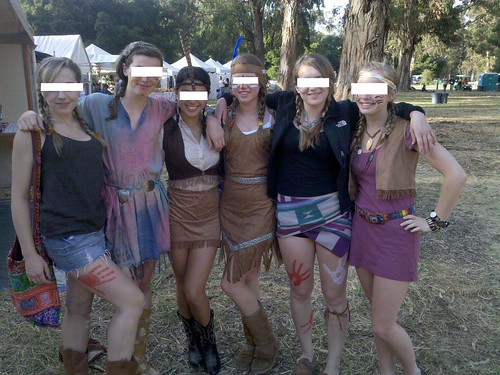
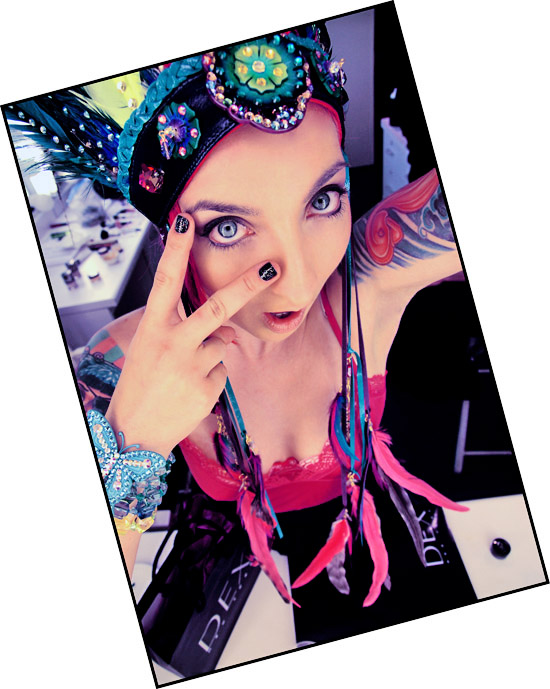
Love Letters and Cultural Appropriation: Gala Darling

i'm very excited to present my first guest contributor, and long-time super awesome friend, iris . she's currently completing her masters in philosophy. her research focusses on connecting disability theory to feminist philosophical frameworks. in her free time, she volunteers at Out on the Shelf, OOTS, a queer bookstore in Guelph, Ontario, drinks lots of tea, and longs for folks to have dance parties with.
Fashion blogger extraordinaire Gala Darling knows a thing about creating a signature style: in some parts of the Internet, her cotton-candy hairstyle, positivity-inducing attitude, and recovering-Goth-meets-Sex-and-the-City outfit posts make her an icon. And Darling makes her money precisely because she is so fabulous: readers of her blog shell out extra cash for installments of her e-book, which promises to teach her acolytes the secrets to attaining her magical, glitter-infused lifestyle for themselves.
Gala Darling is so into personal branding that she has a signature signature: she signs off her posts, “Love Letters and Feather Headdresses, Gala xx”.


Yep, feather headdresses. Gala has been a fan of this hipster-hyped accessory for the latest year or so. Every post, she wishes her reader “feather headdresses” as her parting words. I couldn’t believe what I was reading, but after months of this, when it finally sunk in that, indeed, she was doing it on purpose, and she wasn’t going to realize that this was Classic Cultural Appropriation Fail, I left a comment on her blog asking what was up with the phrase.

Gala’s response was even more cringe-inducing:
So many things I love are from cultures foreign to my own (hip hop, Indian music, Buddhist concepts, etc.), should I ignore those things because I’m a white girl from New Zealand? My life would be much less fabulous if I did! I absolutely believe that culture is something to be shared, delighted in, learned about & cherished…
Rather than engage with the many reasons that Indigenous peoples might not want to have affluent white women wearing their traditional regalia, Darling speaks to the reasons that her own, very privileged lifestyle would lose some of its lustre if she felt she needed to limit her style choices to things that come solely from her own culture.

In doing so, she basically justifies her use of the headdress as part of her own personal branding by saying that it benefits her to do so. And since Darling bases her income on selling the desirability of her own fabulous lifestyle, and in influencing other young women to find that lifestyle desirable, she is literally appropriating Indigenous culture to benefit her own bottom line.

Last week, in a post promoting the latest instalment of her book, Darling describes the transmission of the electronic copies as “whizzing around our heads right now, landing with a splash in the inboxes of international playgirls, glamorous savages & doll-faced geniuses all over the world!” (emphasis mine).

We know that Darling thinks that (at least some) “savages” are glamorous, as we can see from the style inspiration on her blog. But now, she has portrayed herself as selling her own fashion-forward, magical lifestyle back to the folks she stole it from in the first place. I left an admittedly-frustrated comment on her post calling her out on her language, and so did a few other folks I know, but they have all been deleted.


Back on that original post in February, I responded that the problem with cultural appropriation, as I saw it, is that Indigenous folks face discrimination and in some cases have a history of being legally barred from wearing things like headdresses. The hipster headdress is perceived by others as being “fierce” or “exotic” or “creative” or “bohemian” at the same time that Indigenous people who might want to dress similarly would be perceived negatively for doing so. I said that when you are a person who has not invested any time in understanding the widespread racism that Indigenous people and communities face, or the continuing effects of colonialism on those communities, it is especially insensitive and can be straight-up racist to align yourself with those communities by taking something you think is fashionable and using it to make yourself look cool. I asked Gala to think about how “you are taking from that culture and giving nothing back, not even your constructive support.”

But this most recent comment about “savages” shows that, obviously, she hasn’t thought about it. And the fact that Darling is deleting comments that call her out means that she isn’t willing to publicly discuss it, either.

And that’s bullshit. It is time for Darling to have to publicly discuss her Cultural Appropriation beyond a pithy comment about her fabulous lifestyle. And it is time for her to be asked to answer to similar criticisms being made by other bloggers. Why does her blog depict mainly white women? Why, when she talks so much about self-love and body acceptance, does she post photos of thin women almost exclusively?

I love a good fashion blog. I love talking about outfits. But we have no business allowing the representatives of the fashion blog community to be oppressive. Gala Darling needs to be called out. And we need to step up and do it.

There are lots of resources out there already that talk about cultural appropriation and the hipster headdress. Namely, this post at the Cultural Appropriations blog called “But Why Can’t I Wear a Hipster Headdress?”

There are lotsa reasons why, of course, including this one:
By the sheer fact that you live in the United States you are benefiting from the history of genocide and continued colonialism of Native peoples. That land you're standing on? Indian land. Taken illegally so your ancestor who came to the US could buy it and live off it, gaining valuable capital (both monetary and cultural) that passed down through the generations to you. Have I benefited as well, given I was raised in a white, suburban community? yes. absolutely. but by dismissing and minimizing the continued subordination and oppression of Natives in the US by donning your headdress, you are contributing to the culture of power that continues the cycle today.

Two years ago now, Jessica Yee wrote a post about Juliette Lewis’s hipster-headdress appropriation:
But it’s not like this all isn’t a usual occurrence. We in the Native community have to witness this with every kid who dresses up like Pocahontas on Halloween, or every time we turn on the TV to watch the Redskins, Braves, or Indians play. In fact it’s been going on for so damn long that we’re kinda the only race who it’s still happening to on this extreme, public level, to the point where the fight has basically died down. Or has it?
What I find most interesting though about all this imagery, and in particular Lewis’s choice of dress with her band, is actually coming from my raging feminist point of view. In an attempt to appear strong, raw, and unapologetic, people, and in this case, a woman, feels like she has to appropriate Native culture to a pretty extreme extent in order to do a good job of it.

Tuesday, December 8, 2009

words of wisdom: Objectivity & Authenticity: “(Fe)male bodied” / “(Fe)male identified” (Language Politics)

Photobucket

won't show you, september 2009

here is an excerpt from an article published on a great blog called "taking up too much space," and this post was written by cedar. i wanted to share it because it really hits home about a lot of things i've been thinking about lately, the power we have in our bodies and how we chose to present them, but also how we can be stripped of that power because of assumptions others make or impose on our bodies. this is something i have struggled with ever since becoming interested in fashion as an empowering thing; the way i present my body is my choice, but the way it is read is not always something i can predict. as someone who presents themselves on the femme end of the spectrum, i have often struggled with my privilege and had a hard time articulating these feelings, but i feel like cedar says this a lot better and in a clearer way than i can at the moment. click here to read the entire article:

What [the term] '(fe)male bodied' does is try to avoid the messiness of respecting our identities and categorizing us solely that way and find an 'objective' way of talking about people that you can use just by looking at them or by knowing their histories. But this Cartesian mind-body dualism is bunk–my body is still my body, and defining it as male or female is still defining me as male or female, and my body is not this thing that exists wholly separate from my mind, that cannot know or feel things or from which my sense of self can be divorced. My sex and my body are my self determination, don’t try to pry in with the crowbar of coercive language.

Part two is that not only do some people use the term to classify me as 'male bodied' and others use it to classify me as 'female bodied'–but that there’s a reason for this ambiguity. This 'objective' 'neutral' 'real' body that they want to jump to just isn’t there. Some people mean chromosomes, some mean presence or absence of a penis, some people mean hormone levels and how your body appears socially, some people just aren’t thinking about trans and intersex people’s bodies. But the assumption of using the phrase is that people will have half a clue of who you mean, which positions all bodies as belonging to pre-acknowledged sexed categories unambiguously and objectively. Regardless of what categories persons are placed in and how transphobic that placement is, by 'empowering' the listener to do the placing, the term nullifies self-definition of sex/embodiment, and undermines resistance to the binary medical model for being trans.

So while I fully support all people speaking of their bodies as male and/or female (and/or other possibilities), don’t use '(fe)male bodied' as a category of people (based on body parts) as opposed to an individual’s self definition–even if you’re trans.

My body is my identity, my identity is my body. Don’t try to separate them, I went to a lot of effort to help them learn to play nice with each other.

that last line hits home for me. as someone who operates in this world with a certain amount of privilege, as an able-bodied, tall, conventionally attractive, femme-presenting woman, people often forget that i identify as queer and will often make problematic statements to me assuming/hoping i agree with them. (but anyone who knows me knows that i am opinionated and i can't keep my mouth shut if i disagree with you... hell, even if i agree with you) i have had more than a few conversations with cisgendered people who see someone who presents themselves as androgynous and ask me, without hesitating, "do you think that person is a man or a woman?" my response is almost unfaillingly, "maybe they don't fit into either of those definitions, or maybe they want to you to wonder."

Photobucket

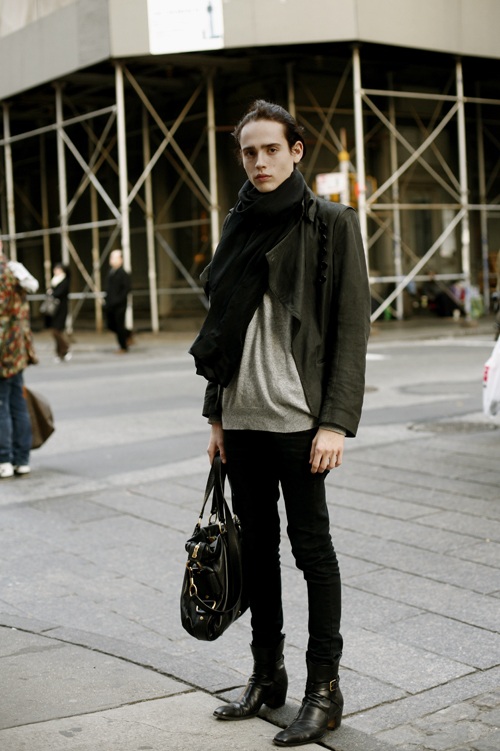
photo from the sartorialist

from the sartorialist, titled "perfect androgyny" yet still tagged as "men"

i think we live in a culture that accepts certain kinds of androgyny in the public sphere (in the glam rock and new wave scenes, thinking of david bowie circa aladdin sane, annie lennox or in the modelling/fashion industry, namely omahyra) but is always confused by it when seen in reality. when someone does not want to go by gendered pronouns. when someone does not want to be read as one or the other. it is all well and good to say "i think it sucks that kids are forced to chose blue or pink" but often those same people are not ready (or willing) to start unlearning the gender dichotomy. that's where the real works needs to be done.

des garçonnes in 1920s europe

my own relationship to gender is a somewhat simple one. for the most part i am happy in my body, and all of my explorations with gender had more to do with a dislike of how i was treated as a girl, not necessarily in relation to my embodied experience. i didn't like getting elbowed in the breasts at punk shows when was sixteen, but who did? i didn't like being disregarded by boys because i was a girl, but who ever does? i became mouthy, loud, opinionated and refused to have my opinions silenced by obnoxious oblivious stupid boys. but this wasn't really manifested in my gender presentation, and i didn't necessarily feel like it needed to be. part of me felt like that was my way of fucking with gender norms; having hair down to my butt, wearing shabby little kid's t-shirts with purple chuck taylors and ugly wool skirts.

the one body i was always drawn to was the androgynous, rowdy flapper. i have always idealized les garçonnes, but my own body does not fit into the spectrum of what a flapper looked like, in that sense, so i try to make up for it in how i act and live. people often say they love flappers for their fashion, the almost parodic halloween costume idea of boas and fringe dresses and cigarette holders, but we often forget that the way the dressed and presented themselves was revolutionary at the time, and was intrinsically connected to fucking up traditional gender roles. many, if not most, were committed to challenging women's traditional societal roles, by doing things that we take for granted today, such as working, drinking in public, choosing not to get married, smoking, etc. it was the first time in modern history that women cut off ridiculous amounts of hair, started doing drag outside of theatres, were open about their sexualities, and threw off the corsets of the past in favour of comfort and freedom... (these are ideas we can talk about in more detail in another post.)

i can idealize flappers all i want, but i will never truly look like one in spite of my haircuts or clothing. i have a tiny waist and big hips, and drop waist dresses look terrible on me. i only bind my breasts when i do drag, because i like the way they feel. i have curves and i've come to accept them and find enjoyment in them. trying to fit into any idealized body definition is not a healthy habit for me and i've been gradually learning to appreciate the one i occupy.

enough about me, back to cedar's points! the other thing i find particularly powerful about this article is that it highlights the fact we embody our identities; that yes, we can accentuate certain things about ourselves with artifice, clothing, decoration, as well as with certain haircuts, piercings, hair or lack of hair, modifications, tattoos, frames/framing, but in the end when you strip it all away, what are our bodies? are they ever truly ours? our own? or will part of our bodies always be public domain? it took me a long time to understand that my relationship to fashion/clothing could not be separated from my relationship to my body/gender. that they fed into one another, that they are interdependent to one another.

i've been working on some stripped-down self-portraits these days as a way of processing a lot of these thoughts, but doubt i will ever feel comfortable enough to show them on the internet. i think there is a lot to be unpacked there (how self-portraits are a powerful way to deal with identity issues, especially in regards to fashion) but that? i will save for another post.

Photobucket

hommage à claude jutra, may 2009