Showing posts with label words of wisdom. Show all posts

Wednesday, October 27, 2010

women with glasses: usurping the gaze


check out my new specs! my mother gave me an early birthday/christmas present: a lovely oxblood pair of burberry glasses. thank goodness, because my last pair were beyond scratched up and my prescription had changed a wee bit. i really enjoyed them but you know how it goes, even the best of glasses don't really last more than two or three years. especially when you are too broke to afford contacts and you have no choice but to wear them day in, day out.

here they are for reference:


in a perfect world, i would be able to find a pair of vintage cateye glasses that comfortable fit me, or would have enough money to splurge on a pair from urban spectacles. i think these would suit me quite nicely:


i do have a pair of vintage frames but with clear lenses, but they are a little broken and a little too small for me. here's a picture from when i first got them in winter 2009:


but this post isn't about me! it's about women who wear glasses in general. it's only recently that i've really started to enjoy wearing glasses 24/7 (well, aside from the time spent sleeping, of course). i have a lot more theoretical ideas about women and glasses but those are thoughts we can flesh out another time. here are some photos of women who wear glasses exquisitely well:


The woman who wears glasses constitutes one of the most intense visual clichés of the cinema. The image is a heavily marked condesation of motifs concerned with repressed sexuality, knowledge, visibility and vision, intellectuality, and desire.
The woman with glasses signifies simultaneously intellectuality and undesirability; but the moment the removes her glasses (a moment which, it seems, must almost always be shown and which is itself linked with a certain sensual quality), she is transformed into spectacle, the very picture of desire. Now, it must be remembered that the cliché is a heavily loaded moment of signification, a social knot of meaning. It is characterized by
an effect of ease and naturalness. Yet, the cliché has a binding power so strong that it indicates a precise moment of ideological danger or threat — in this case, the woman’s appropriation of the gaze. Glasses worn by a woman in the cinema do not generally signify a deficiency in seeing but an active looking, or even simply the fact of seeing as opposed to being seen. The intellectual woman looks and analyses, and in usurping the gaze she poses a threat to an entire system of representation.


roxanne aka persephassa. aren't these just wonderful? flashy but understated, i think they go so well with her complexion. you can even get the same pair on ebay! roxanne has pretty much the best taste of anyone ever in the history of the world, so it is unsurprising all of her glasses are magnificent.


the girl from hk, ldn & sf
it was so hard to just pick one picture of her, she has so many lovely frames!


one day you will be mine, perfect cat eye frames that are in my price range.
from framesbaby

Sunday, August 8, 2010

what i wore today: femme tea party


pervers/cité is happening in montreal this week, and let me tell you i am wishing i could be there. yesterday, there was a femme tea party happening in montreal at parc jarry from two to five. seriously, how can you resist an awesome (bilingual!) invitation like this one:
Mixer for femmes of all genders and our friends! Come frolic in all your finery and enjoy a terribly refined afternoon of iced tea, cupcakes, games and a fabulous femme photoshoot. Rain or shine.
seriously. what femme is not reading that and thinking "AH I WISH I COULD HAVE BEEN THERE!"

if you're like me, and couldn't make it there, what would you have worn? instead of moping around about the fact that i couldn't meet up with some of my wonderfully sexy montrealer queers, like my friend jesse, i decided to get dressed up anyway, even though i just had a pretty dreary lazy sunday at home and running errands.

here's my outfit:

vintage hat + veil: emmaüs thrift store, qc
necklace: gift from meghan
shirt: zara, thrifted from le vestiaire
black shawl: le vestiaire
gloves: from le vestiaire
sandals: thrifted from village des valeurs, qc.


and then i had tea for one.


did any of my readers out there attend the femme tea party? i can't wait to see the results of the photoshoot! what did you wear? what kinds of conversations did you have? how gorgeous did everyone look?

oh yes! and i almost forgot, i have a little announcement: yeah, sure, i love writing about fashion culture from a critical feminist perspective here, but i like to write about other things, too! film, for one! shameless mag invited me to cover film fridays over there starting next week. i can't decide whether to start with the runaways or youth in revolt... comment there to make requests and all that jazz.

until then,

xo
julia

recommending reading browsing
pervercité - official website
fuck yeah femmes - tumblr
5 feminist conversations i'm over - number 6!

Monday, March 29, 2010

words of wisdom: embodied resistance/oppression


photo by anja, cross-stitching by amelia (who both have awesome blogs you should read)

march has been a whirlwind and i've been trying to think up ways to update this blog on a more regular basis without getting caught up in not having the time to edit my 3,000 word essays every time i try to write about something. so here is a new little feature that i'll try to do from time to time, sort of like feministing's weekly feminist reader where i suggest some links and you can comment with your own favourite things you've read as of late. i'll start with some quotes that have really caught my attention lately.
The theme of rescue through benevolence underpins power relations and gives expression to those relations in a way that "makes sense." Thus difference, which is threatening, can similarly be recuperated through its conversion into exotica, or its neutralization through containment. In speaking of the exotic, it is apparent that imperial literature was replete with representations constructing women from the East and other parts of the wolrd as exotic Others who need to be unveiled so that their hidden natures could be consumed by the colonizers.
- Mapping Race in the Media by Yasmin Jiwani in Discourses of Denial, entire book available for download in pdf form here.
Sympathy or even empathy that is not coupled with power-sharing is meaningless. Any story that purports to show solidarity or uplift marginalised groups, but is not willing to let us tell our own stories in our own way, is not a friend.
- Stories that Ally versus Stories that Appropriate by Thea Lim, via Racialicious

I am a woman, and present myself as such. This does not mean I am anybody else’s expectation of what a woman is, but my own. I’m always reinventing the meaning of womanhood by just being myself, and knowing that whatever the result of being myself is, it is being a woman. I think that goes for everybody and any gender identity they may have.

- Anonymous, via Genderfork
There is no automatic or axiomatic relationship between a particular sexual act and the identity of the person performing it.
- Anonymous, via fuckyeahfemmes

...When we appeal to some notion of an unmodified or undecorated body, we participate in the adoption of a false neutrality. We pretend, in those moments, that there is a natural body or fashion, a way of dressing or wearing yourself that is not a product of culture. Norms always masquerade as non-choices, and when we suggest that for example, resisting sexism means everyone should look androgynous, or resisting racism means no one should modify the texture of their hair, we foreclose people’s abilities to expose the workings of fucked up systems on their bodies as they see fit.
- Dress to Kill, Fight to Win by Dean Spade (you really need to read the whole thing)

and last but not least, a little less about fashion and more about decor (which has been on my mind a lot these days), a quote from the Globe and Mail: Russell Smith's A lament for the bookshelf:

Bric-a-brac is generally unfashionable now. Designers see apartments full of amusing memorabilia – the matchboxes from Berlin, the Soweto tin car, all the stuff that children love – as dust-gathering and space-consuming. We no longer respect the Cabinet of Wonders as a guiding principle of decoration. So we lose forever the pleasure known to humanity for 500 years of taking a stroll up and down the aisles of someone else’s brain by perusing their bookshelves. Gone will be the guilty joy of spending a rainy afternoon at a cottage with the remnants of someone else’s childhood: their Nancy Drews, their 1970s National Geographics. Without bookshelves, you will never know the warning signs contained in the e-reader of your handsome date – you will not know for months that he is reading The Secret and Feng Shui for Dummies, even if you stay over. You will never be able to ask, as casually as you can, “Did you like this?” as you pull down, as if fascinated, Patrick Swayze’s autobiography.

hopefully that gives you some food for thought! share any great quotes you've stumbled upon lately in the comments.

to end off, a lot of people ask me how i find all of these awesome things on the internet, and wonder if i spend every waking minute of the day online simply googling "awesome things." sadly, it is not that simple and i really don't spend that much time in front of my computer. thanks to people i know both in real life and online, we share our favourite things with each other via emails, our livejournals, our tumblrs and our blogs. (unimportant sidenote: i know lots of people would argue that lj, tumblr and blogs are all "blogs" but i always feel the need to differentiate) and since most of these quotes came to my attention via some of these wonderful people i will give you some links so you can cut out the middle (wo)man! i'm posting their tumblrs because those are their most public places and where they most often share awesome quotes like the aforementioned ones.

bookselves.tumblr.com
sweaterves.tumblr.com/emptystomachs.tumblr.com
definatalie.tumblr.com
transartorialism.tumblr.com
fuckyeahfemmes.tumblr.com

enjoy!

Tuesday, December 8, 2009

words of wisdom: Objectivity & Authenticity: “(Fe)male bodied” / “(Fe)male identified” (Language Politics)

Photobucket

won't show you, september 2009

here is an excerpt from an article published on a great blog called "taking up too much space," and this post was written by cedar. i wanted to share it because it really hits home about a lot of things i've been thinking about lately, the power we have in our bodies and how we chose to present them, but also how we can be stripped of that power because of assumptions others make or impose on our bodies. this is something i have struggled with ever since becoming interested in fashion as an empowering thing; the way i present my body is my choice, but the way it is read is not always something i can predict. as someone who presents themselves on the femme end of the spectrum, i have often struggled with my privilege and had a hard time articulating these feelings, but i feel like cedar says this a lot better and in a clearer way than i can at the moment. click here to read the entire article:

What [the term] '(fe)male bodied' does is try to avoid the messiness of respecting our identities and categorizing us solely that way and find an 'objective' way of talking about people that you can use just by looking at them or by knowing their histories. But this Cartesian mind-body dualism is bunk–my body is still my body, and defining it as male or female is still defining me as male or female, and my body is not this thing that exists wholly separate from my mind, that cannot know or feel things or from which my sense of self can be divorced. My sex and my body are my self determination, don’t try to pry in with the crowbar of coercive language.

Part two is that not only do some people use the term to classify me as 'male bodied' and others use it to classify me as 'female bodied'–but that there’s a reason for this ambiguity. This 'objective' 'neutral' 'real' body that they want to jump to just isn’t there. Some people mean chromosomes, some mean presence or absence of a penis, some people mean hormone levels and how your body appears socially, some people just aren’t thinking about trans and intersex people’s bodies. But the assumption of using the phrase is that people will have half a clue of who you mean, which positions all bodies as belonging to pre-acknowledged sexed categories unambiguously and objectively. Regardless of what categories persons are placed in and how transphobic that placement is, by 'empowering' the listener to do the placing, the term nullifies self-definition of sex/embodiment, and undermines resistance to the binary medical model for being trans.

So while I fully support all people speaking of their bodies as male and/or female (and/or other possibilities), don’t use '(fe)male bodied' as a category of people (based on body parts) as opposed to an individual’s self definition–even if you’re trans.

My body is my identity, my identity is my body. Don’t try to separate them, I went to a lot of effort to help them learn to play nice with each other.

that last line hits home for me. as someone who operates in this world with a certain amount of privilege, as an able-bodied, tall, conventionally attractive, femme-presenting woman, people often forget that i identify as queer and will often make problematic statements to me assuming/hoping i agree with them. (but anyone who knows me knows that i am opinionated and i can't keep my mouth shut if i disagree with you... hell, even if i agree with you) i have had more than a few conversations with cisgendered people who see someone who presents themselves as androgynous and ask me, without hesitating, "do you think that person is a man or a woman?" my response is almost unfaillingly, "maybe they don't fit into either of those definitions, or maybe they want to you to wonder."

Photobucket

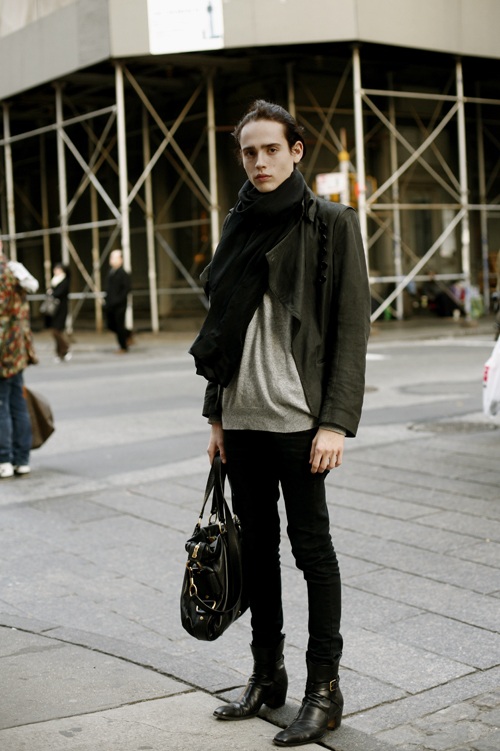
photo from the sartorialist

from the sartorialist, titled "perfect androgyny" yet still tagged as "men"

i think we live in a culture that accepts certain kinds of androgyny in the public sphere (in the glam rock and new wave scenes, thinking of david bowie circa aladdin sane, annie lennox or in the modelling/fashion industry, namely omahyra) but is always confused by it when seen in reality. when someone does not want to go by gendered pronouns. when someone does not want to be read as one or the other. it is all well and good to say "i think it sucks that kids are forced to chose blue or pink" but often those same people are not ready (or willing) to start unlearning the gender dichotomy. that's where the real works needs to be done.

des garçonnes in 1920s europe

my own relationship to gender is a somewhat simple one. for the most part i am happy in my body, and all of my explorations with gender had more to do with a dislike of how i was treated as a girl, not necessarily in relation to my embodied experience. i didn't like getting elbowed in the breasts at punk shows when was sixteen, but who did? i didn't like being disregarded by boys because i was a girl, but who ever does? i became mouthy, loud, opinionated and refused to have my opinions silenced by obnoxious oblivious stupid boys. but this wasn't really manifested in my gender presentation, and i didn't necessarily feel like it needed to be. part of me felt like that was my way of fucking with gender norms; having hair down to my butt, wearing shabby little kid's t-shirts with purple chuck taylors and ugly wool skirts.

the one body i was always drawn to was the androgynous, rowdy flapper. i have always idealized les garçonnes, but my own body does not fit into the spectrum of what a flapper looked like, in that sense, so i try to make up for it in how i act and live. people often say they love flappers for their fashion, the almost parodic halloween costume idea of boas and fringe dresses and cigarette holders, but we often forget that the way the dressed and presented themselves was revolutionary at the time, and was intrinsically connected to fucking up traditional gender roles. many, if not most, were committed to challenging women's traditional societal roles, by doing things that we take for granted today, such as working, drinking in public, choosing not to get married, smoking, etc. it was the first time in modern history that women cut off ridiculous amounts of hair, started doing drag outside of theatres, were open about their sexualities, and threw off the corsets of the past in favour of comfort and freedom... (these are ideas we can talk about in more detail in another post.)

i can idealize flappers all i want, but i will never truly look like one in spite of my haircuts or clothing. i have a tiny waist and big hips, and drop waist dresses look terrible on me. i only bind my breasts when i do drag, because i like the way they feel. i have curves and i've come to accept them and find enjoyment in them. trying to fit into any idealized body definition is not a healthy habit for me and i've been gradually learning to appreciate the one i occupy.

enough about me, back to cedar's points! the other thing i find particularly powerful about this article is that it highlights the fact we embody our identities; that yes, we can accentuate certain things about ourselves with artifice, clothing, decoration, as well as with certain haircuts, piercings, hair or lack of hair, modifications, tattoos, frames/framing, but in the end when you strip it all away, what are our bodies? are they ever truly ours? our own? or will part of our bodies always be public domain? it took me a long time to understand that my relationship to fashion/clothing could not be separated from my relationship to my body/gender. that they fed into one another, that they are interdependent to one another.

i've been working on some stripped-down self-portraits these days as a way of processing a lot of these thoughts, but doubt i will ever feel comfortable enough to show them on the internet. i think there is a lot to be unpacked there (how self-portraits are a powerful way to deal with identity issues, especially in regards to fashion) but that? i will save for another post.

Photobucket

hommage à claude jutra, may 2009